

Is -7 A Real Number
Real numbers are simply the combination of rational and irrational numbers, in the number arrangement. In full general, all the arithmetic operations tin can be performed on these numbers and they can exist represented in the number line, as well. At the same time, the imaginary numbers are the un-real numbers, which cannot be expressed in the number line and are commonly used to represent a complex number. Some of the examples of existent numbers are 23, -12, half dozen.99, five/two, π, and so on. In this article, we are going to talk over the definition of real numbers, the backdrop of real numbers and the examples of existent numbers with consummate explanations.
Tabular array of contents:
- Definition
- Set of real numbers
- Chart
- Properties of Existent Numbers
- Commutative
- Associative
- Distributive
- Identity
- Solved Examples
- Practice Questions
- FAQs
Existent Numbers Definition
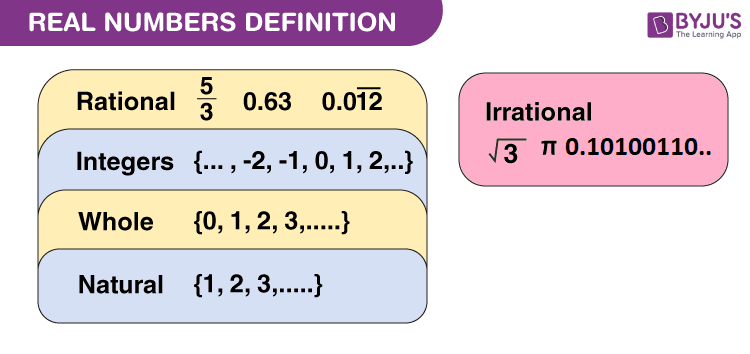
Existent numbers tin can exist divers as the union of both rational and irrational numbers. They tin be both positive or negative and are denoted by the symbol "R". All the natural numbers, decimals and fractions come up nether this category. See the figure, given beneath, which shows the nomenclature of real numerals.
Read More:
- Natural Numbers And Whole Numbers
- Rational And Irrational Numbers
- Integers
- Real Numbers For Form 10
- Important Questions Grade 10 Maths Chapter one Existent Numbers
Set of Real Numbers
The set of real numbers consists of different categories, such equally natural and whole numbers, integers, rational and irrational numbers. In the table given below, all the real numbers formulas (i.e.) the representation of the classification of real numbers are defined with examples.
| Category | Definition | Instance |
|---|---|---|
| Natural Numbers | Comprise all counting numbers which kickoff from 1. N = {1, 2, 3, 4,……} | All numbers such as 1, 2, three, iv, 5, 6,…..… |
| Whole Numbers | Collection of zero and natural numbers. W = {0, 1, 2, 3,…..} | All numbers including 0 such every bit 0, 1, 2, 3, 4, v, 6,…..… |
| Integers | The collective result of whole numbers and negative of all natural numbers. | Includes: -infinity (-∞),……..-four, -iii, -two, -1, 0, ane, 2, 3, 4, ……+infinity (+∞) |
| Rational Numbers | Numbers that can be written in the course of p/q, where q≠0. | Examples of rational numbers are ½, 5/iv and 12/6 etc. |
| Irrational Numbers | The numbers which are not rational and cannot be written in the form of p/q. | Irrational numbers are non-terminating and not-repeating in nature like √2. |

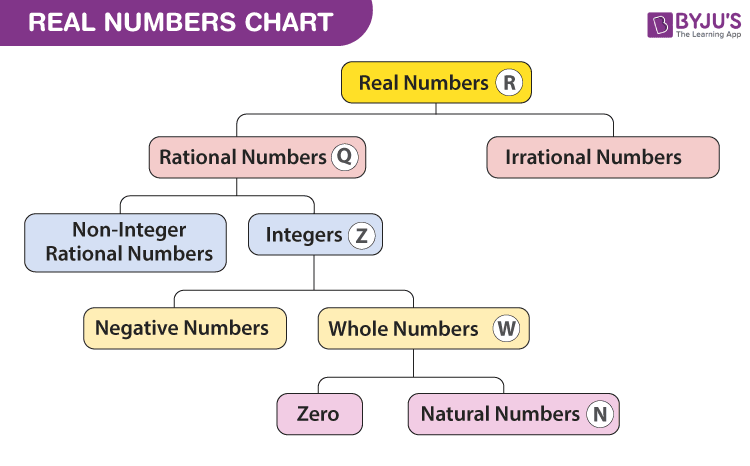
Real Numbers Chart
The nautical chart for the gear up of real numerals including all the types are given beneath:
Properties of Real Numbers
The following are the four principal properties of real numbers:
- Commutative holding
- Associative property
- Distributive property
- Identity holding
Consider "one thousand, northward and r" are iii real numbers. Then the above properties tin be described using m, northward, and r equally shown beneath:
Commutative Holding
If g and north are the numbers, then the general form will be m + north = n + m for addition and k.north = n.m for multiplication.
- Add-on: m + northward = n + m. For example, 5 + 3 = 3 + 5, 2 + four = iv + ii.
- Multiplication: m × n = n × grand. For example, 5 × iii = iii × five, two × 4 = iv × 2.
Associative Belongings
If m, north and r are the numbers. The general class will be one thousand + (n + r) = (g + n) + r for add-on(mn) r = thou (nr) for multiplication.
- Improver: The general form will exist m + (n + r) = (thousand + n) + r. An example of additive associative property is 10 + (3 + ii) = (10 + three) + ii.
- Multiplication: (mn) r = m (nr). An example of a multiplicative associative property is (2 × three) 4 = 2 (iii × iv).
Distributive Holding
For three numbers one thousand, due north, and r, which are real in nature, the distributive property is represented equally:
m (n + r) = mn + mr and (m + north) r = mr + nr.
- Case of distributive property is: 5(two + 3) = five × two + five × 3. Hither, both sides will yield 25.
Identity Property
There are condiment and multiplicative identities.
- For addition: m + 0 = thou. (0 is the condiment identity)
- For multiplication: one thousand × 1 = 1 × thousand = m. (ane is the multiplicative identity)
Video Lesson on Numbers
Solved Examples
Example 1:
Find 5 rational numbers between i/2 and iii/5.
Solution:
Nosotros shall make the denominator same for both the given rational number
(1 × 5)/(2 × five) = 5/10 and (3 × 2)/(v × 2) = 6/10
Now, multiply both the numerator and denominator of both the rational number past 6, we have
(5 × 6)/(10 × half-dozen) = 30/lx and (6 × 6)/(10 × 6) = 36/60
Five rational numbers between 1/ii = 30/threescore and three/v = 36/lx are
31/60, 32/60, 33/60, 34/sixty, 35/60.
Instance ii:
Write the decimal equivalent of the post-obit:
(i) 1/4 (ii) five/8 (three) three/2
Solution:
(i) 1/four = (1 × 25)/(4 × 25) = 25/100 = 0.25
(ii) 5/eight = (v × 125)/(8 × 125) = 625/1000 = 0.625
(three) 3/ii = (three × five)/(2 × five) = xv/10 = ane.5
Example 3:
What should be multiplied to ane.25 to go the answer one?
Solution: 1.25 = 125/100
At present if we multiply this by 100/125, we become
125/100 × 100/125 = ane
Practice Questions
- Which is the smallest composite number?
- Evidence that any positive odd integer is of the form 6x + 1, 6x + 3, or 6x + 5.
- Evaluate ii + 3 × 6 – 5.
- What is the product of a non-goose egg rational number and an irrational number?
- Tin can every positive integer be represented as 4x + 2 (where x is an integer)?
Existent Numbers Form 9 and 10
In real numbers Class 9, the common concepts introduced include representing existent numbers on a number line, operations on real numbers, properties of real numbers, and the constabulary of exponents for existent numbers. In Class 10, some advanced concepts related to existent numbers are included. Apart from what are real numbers, students will also learn almost the real numbers formulas and concepts such as Euclid'south Partition Lemma, Euclid's Partition Algorithm and the primal theorem of arithmetic in form 10.
Keep visiting BYJU'S to get more such Maths lessons in a simple, concise and easy to understand way. Also, register at BYJU'S – The Learning App to become consummate help for Maths preparation with video lessons, notes, tips and other report materials.
Frequently Asked Questions on Real Numbers
What are Natural and Real Numbers?
Natural numbers are all positive integers starting from one to infinity. All natural numbers are integers but not all the integers are natural numbers. These are the set up of all counting numbers such as 1, ii, 3, 4, 5, half dozen, 7, 8, 9, …….∞.
Real numbers are numbers that include both rational and irrational numbers. Rational numbers such every bit integers (-2, 0, one), fractions(1/ii, two.v) and irrational numbers such as √3, π(22/7), etc., are all real numbers.
Is Zero a Real or an Imaginary Number?
Null is considered to be both a real and an imaginary number. Every bit we know, imaginary numbers are the foursquare root of non-positive existent numbers. And since 0 is also a non-positive number, therefore it fulfils the criteria of the imaginary number. Whereas 0 is also a rational number, which is defined in a number line and hence a existent number.
Are at that place Real Numbers that are not Rational or Irrational?
No, there are no existent numbers that are neither rational nor irrational. The definition of real numbers itself states that it is a combination of both rational and irrational numbers.
Is the real number a subset of a complex number?
Yep, because a complex number is the combination of a real and imaginary number. So, if the complex number is a set so the real and imaginary numbers are the subsets of it.
What are the properties of real numbers?
The properties of real numbers are:
Commutative Property
Associative Property
Distributive Holding
Identity Property
Is √3 a existent number?
Yes, √3 is a real number. We know that a existent number is a combination of both rational and irrational numbers. Since √3 is an irrational number, we can also say that √3 is a real number.
Is 3i a real number?
No, 3i is non a real number, as it has an imaginary part in it.
What are the different subsets of existent numbers?
The subsets of real numbers include rational numbers, irrational numbers, natural numbers, and whole numbers.

Is -7 A Real Number,
Source: https://byjus.com/maths/real-numbers/
Posted by: allisonwonelf53.blogspot.com
0 Response to "Is -7 A Real Number"
Post a Comment